Health Insurance in Schools and Colleges: Why the Gap Is Bigger Than You Think

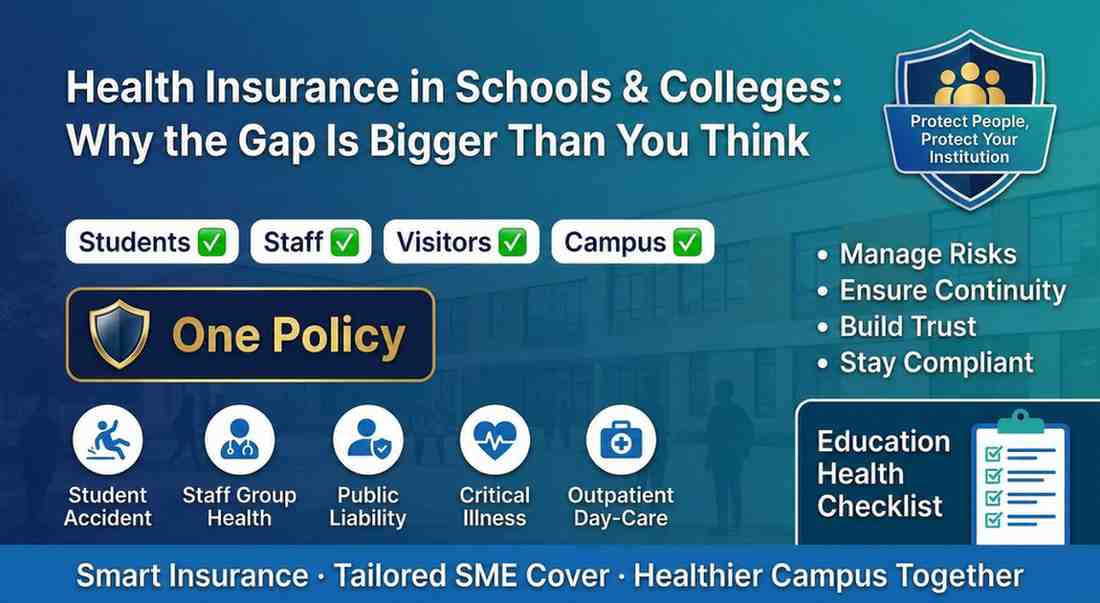
Managing a school or college in India involves an enormous amount of responsibility—yet health insurance remains one of the most overlooked risks. From student accidents to staff medical emergencies, fragmented policies leave institutions exposed when it matters most. school health insurance | college health insurance | SME cover | education health checklist
Managing a school or college in India involves an enormous amount of responsibility—academic quality, infrastructure, staff retention, regulatory compliance, and increasingly, student welfare. Yet one area that continues to be poorly handled across educational institutions of all sizes is health insurance. The chaos is not always visible until something goes wrong: a student is hospitalised, a teacher faces a medical emergency, or a campus accident leads to a legal dispute. At that point, the absence of proper school health insurance becomes impossible to ignore.
This is not a problem limited to underfunded government institutions. Private schools, deemed universities, and standalone colleges often operate with patchwork coverage—a group mediclaim here, a basic accident policy there—without any coherent framework tying it together. The result is confusion at the time of a claim and, in many cases, significant uninsured losses.
The Unique Risk Profile of an Educational Institution
Educational institutions are not offices. They house large numbers of people—students, teaching staff, administrative staff, support workers, and visiting parents—across sprawling campuses with laboratories, sports facilities, canteens, hostels, and transport fleets. Each of these environments carries its own set of health and safety risks.
A chemistry laboratory accident, a sports injury during inter-school competitions, a food poisoning incident in the dining hall, or a medical emergency in a hostel dormitory—these are not hypothetical scenarios. They happen across Indian campuses regularly. Without the right school health insurance framework in place, the institution is left managing both the human cost and the financial fallout simultaneously.
For institutions that operate as small or medium-sized enterprises—a category that covers the vast majority of private schools and standalone colleges in India—the financial exposure from a single uninsured incident can be significant. This is where a structured SME cover designed for the education sector becomes essential.
What School Health Insurance Should Actually Include
A well-structured school health insurance policy is not simply a group mediclaim plan for teachers. It is a layered framework that addresses the different categories of people on campus and the different types of incidents that can arise. At a minimum, it should cover:
• Student personal accident cover—addressing injuries sustained on school or college premises, during school-organised events, and during transit on school transport.
• Staff group health insurance—providing hospitalisation cover for teaching and non-teaching staff, including pre- and post-hospitalisation expenses.
• Public liability cover—protecting the institution against third-party claims arising from accidents or incidents on campus.
• Critical illness cover for senior staff—given that many experienced educators and administrators are in age brackets with elevated health risks.
• Outpatient and day-care cover—particularly relevant for residential institutions where students may need frequent medical attention without full hospitalisation.
The tendency to treat school health insurance as synonymous with a basic staff mediclaim is where most institutions go wrong. Students—especially in residential settings—represent a significant and often uninsured liability. Parents increasingly expect their children to be covered whilst under the institution's care, and regulators are beginning to take note.
College Health Insurance: A More Complex Picture
Colleges and universities face an even more intricate risk landscape than schools. Students are adults, often living independently in hostels or paying-guest accommodations. They may not be covered under their family's health insurance once they cross a certain age. College health insurance fills this gap—and forward-thinking institutions are beginning to recognise this as part of their duty of care.
Beyond students, college campuses often employ visiting faculty, contract workers, laboratory technicians, canteen staff, security personnel, and groundskeepers. Many of these workers fall outside the scope of standard staff policies, leaving institutions exposed to liability if an incident occurs. Comprehensive college health insurance must account for all categories of people associated with the institution—not just the permanent teaching staff.
Additionally, colleges with research facilities, engineering workshops, or medical and nursing programmes carry specialised risks that standard health policies may exclude. These institutions need to work with insurers who understand sector-specific exposures and can offer cover that genuinely reflects the nature of the activities taking place on campus.
The Education Health Checklist: Getting the Basics Right
Before reviewing any insurance policy, every institution should conduct an internal audit of its current health and safety framework. This education health checklist is not about compliance box-ticking—it is about understanding what risks exist and ensuring cover is adequate. Key items include:
• A complete and current register of all staff, contract workers, and their employment classifications.
• A clear record of student enrolment, including residential students and those on external placements or internships.
• Documentation of all on-campus facilities—laboratories, sports grounds, canteens, hostels, transport—and their associated risk assessments.
• Review of existing insurance policies, including expiry dates, coverage limits, and exclusions.
• An understanding of any regulatory requirements around student or staff health cover applicable to your institution type.
• First aid and emergency response protocols, including on-campus medical facilities and nearest empanelled hospitals.
• Procedures for reporting and documenting incidents for potential insurance claims.
Completing this education health checklist before approaching insurers allows institutions to have a far more productive and accurate conversation about their cover needs. It also helps avoid the common problem of under-insurance, where a claim is settled for less than the actual loss because the policy was not structured to reflect the true scale of the institution's operations.
Why SME Cover Makes Sense for Independent Educational Institutions
India's education sector is largely driven by independent, privately managed institutions that operate with moderate budgets and lean administrative teams. For these operators, managing separate policies for staff health, student accidents, public liability, and property is both administratively burdensome and often cost-inefficient.
SME cover packages designed for the education sector bundle these protections into a single, manageable policy. The advantages are practical: one renewal date, one insurer relationship, one premium to budget for, and a policy structure that has been designed with the institution's specific risk profile in mind. For school and college administrators who are not insurance specialists, this simplicity is valuable.
Importantly, SME cover can also be scaled. A primary school with a small enrolment has very different cover requirements from a large engineering college with multiple campuses and thousands of students. The right SME cover framework accommodates this variability without forcing smaller institutions to pay for coverage they do not need, or larger ones to accept limits that leave them exposed.
Common Mistakes Educational Institutions Make With Health Cover
Across schools and colleges, certain patterns of insurance mismanagement tend to repeat themselves. Being aware of them is the first step to avoiding them:
• Insuring only permanent staff and ignoring contract workers, visiting faculty, and support staff who spend significant time on campus.
• Treating student cover as the parents' responsibility and not the institution's, which creates liability gaps when incidents occur on school premises.
• Purchasing the cheapest available group mediclaim without understanding its exclusions, sub-limits, or network hospital restrictions.
• Failing to update sum insured values as staff strength or student enrolment grows, leading to under-insurance at the time of a claim.
• Not having any protocol for documenting incidents, which complicates the claims process and often results in delayed or disputed settlements.
Health Insurance as Part of Institutional Responsibility
There is a broader conversation to be had here about what it means to run a responsible educational institution in India today. Parents entrust schools and colleges with their children's well-being for a significant portion of each day—and in the case of residential institutions, around the clock. Staff spend the majority of their working lives within the institution's environment. Both groups deserve the assurance that the institution has taken their health and safety seriously enough to put proper cover in place.
School health insurance and college health insurance are not just financial products. They are a signal to every stakeholder—students, parents, staff, and regulators—that the institution takes its duty of care seriously. In a sector where reputation is everything, that signal matters.
Sorting Out the Chaos Starts With a Clear Assessment
The health insurance chaos that characterises many Indian educational institutions is not inevitable. It is the product of delayed decision-making, fragmented policies, and a lack of specialist guidance. The solution does not require a large budget or a complex restructuring exercise—it requires clarity about who and what needs to be covered, an honest assessment of existing gaps, and a conversation with an adviser who understands the education sector.
Start with the education health checklist. Identify your people, your facilities, and your risks. Then look for SME cover that has been built for institutions like yours—one that brings together student, staff, and liability protection under a single, coherent framework. The chaos is avoidable. The cost of ignoring it is not.